Home / Work / Automated Disclosure
Compliance UX Voice-Triggered Design Financial Services Solo Project

Automated Regulatory Disclosure Delivery

Replaced manual, verbatim disclosure reading on deposit, loan, and student loan calls with an on-screen, voice-triggered playback system, removing compliance outcomes from an agent's memory under pressure.

Role

Product Designer (Solo Project)

Company

Capital One (formerly Discover Financial Services)

Year

2025–2026

Status

In Production

Agents handling deposit, loan, and student loan calls are required to deliver specific regulatory disclosures verbatim, covering things like income verification requirements and account terms. For years, this depended entirely on an agent correctly recalling and reading dense legal language aloud in real time, while also managing the live conversation with a customer. I identified this as a recurring source of compliance risk and designed and built a solo project to fix it: an automated, voice-triggered disclosure system that plays the required disclosure as audio, follows along with a live transcript, and falls back to a clearly marked verbatim script if playback ever fails.

Confidentiality Note Some terminology, disclosure language, and account scenarios have been generalized to protect confidential information. The design problem, approach, and outcomes reflect the real work.
Impact Eliminated compliance violations tied to manual, memory-dependent disclosure reading
Structure Voice-triggered playback with live transcript, plus a guaranteed verbatim fallback
Delivery Solo-designed and shipped to production

Regulatory disclosures for certain deposit, loan, and student loan interactions have to be delivered exactly as written, with no paraphrasing and no skipped sections. Historically, this relied entirely on the agent remembering to read the correct disclosure, finding the right version for the situation, and reading it precisely under the pressure of a live call. When any of that broke down, whether an agent skipped a line, paraphrased under time pressure, or simply forgot the disclosure existed for that scenario, it created a real, logged compliance violation.

The core issue wasn't agent competence. It was that the process placed a hard compliance requirement entirely on human memory and recall in a high-pressure, real-time environment, with no system-level guardrail to catch the moments when that recall failed.

The central decision was to take the disclosure out of the agent's head entirely. Instead of relying on memory, the agent selects a language and triggers a pre-recorded disclosure to play directly for the customer, while a live transcript displays on screen so the agent can follow along and confirm nothing was missed.

Just as important as the happy path was designing for failure. Audio playback can fail for reasons outside anyone's control, a bad connection, a technical glitch, so the flow includes an explicit fallback: if playback doesn't work, the interface auto-selects a "read verbatim" mode and displays the full disclosure script in a clearly bordered, impossible-to-miss format, with an explicit instruction not to paraphrase or skip any portion. Compliance was designed to hold whether or not the audio actually played.

This was a self-initiated solo project. I identified the compliance risk, proposed the automated disclosure concept, and owned the full design process end to end, including the flow structure, the language toggle, the live transcript pairing, and the fallback state design, partnering with compliance and engineering stakeholders to validate the exact disclosure language and failure-mode requirements before it shipped to production.

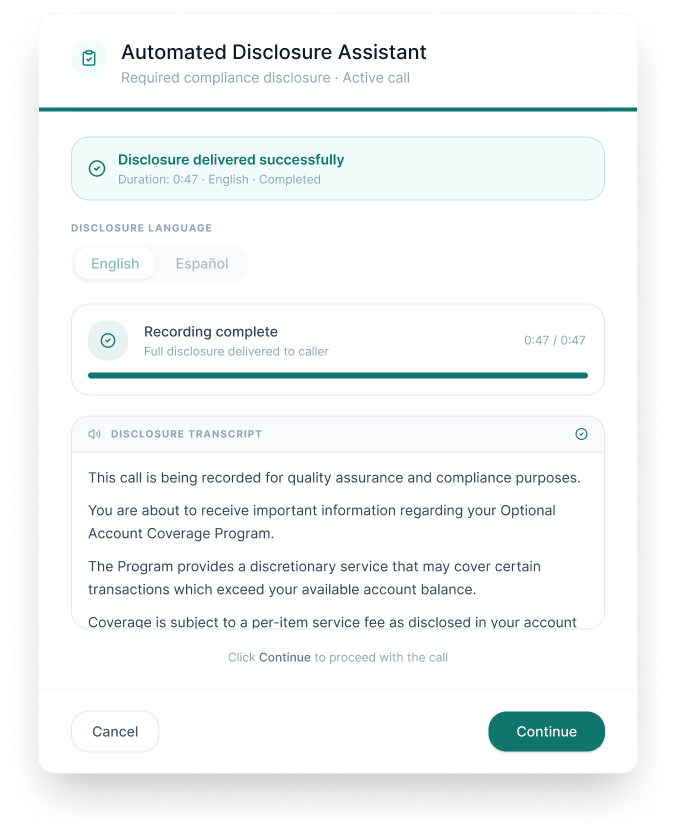
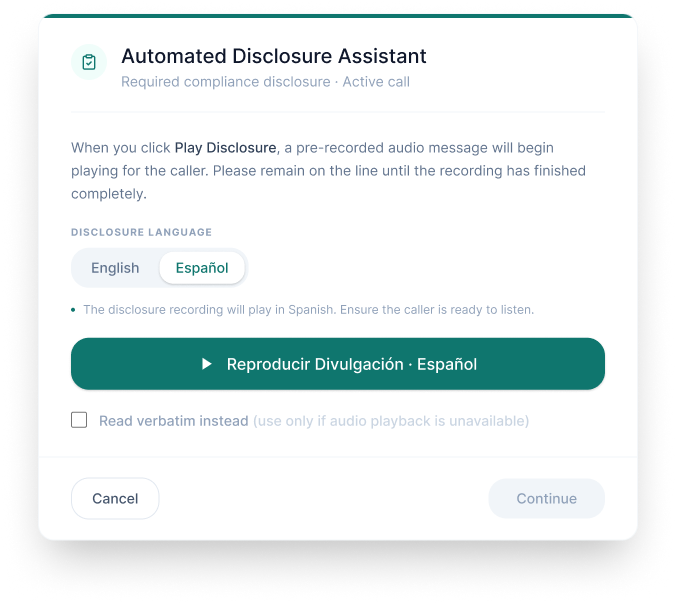
The flow moves through five states: selecting a language, playing the disclosure with a live transcript, confirming delivery once complete, and a distinct fallback if playback is ever unavailable.
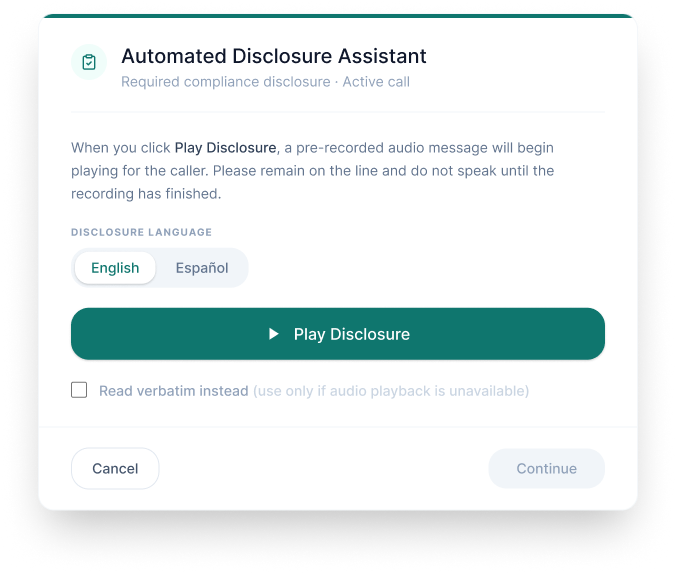
Default state, English selected, ready to play disclosure
Spanish language selected before playback

Language selection: agents choose English or Spanish before the disclosure plays
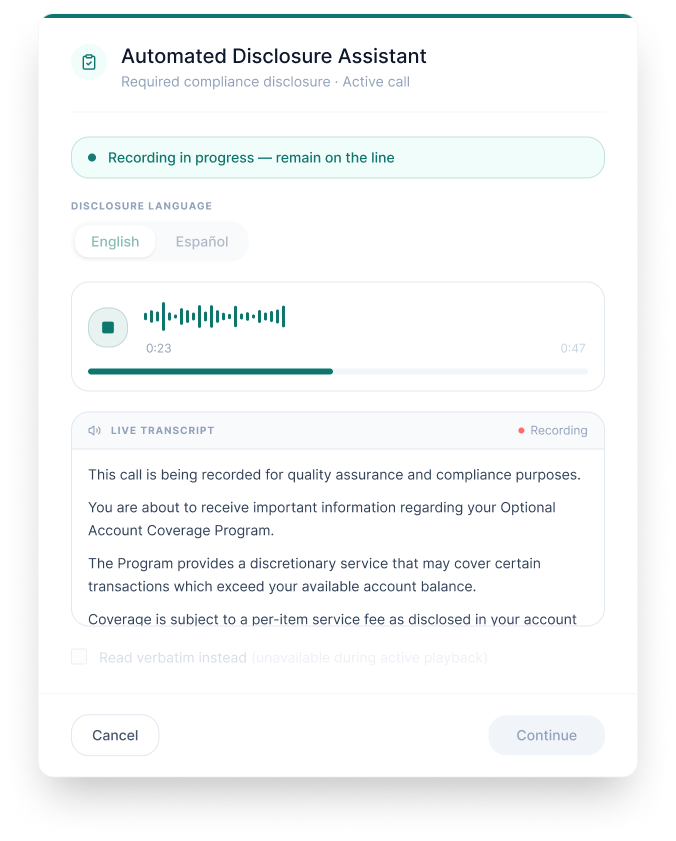
Disclosure playing with live transcript following along
Disclosure delivered successfully with full transcript for reference

Live playback with a synced transcript, followed by confirmation once the full disclosure has been delivered
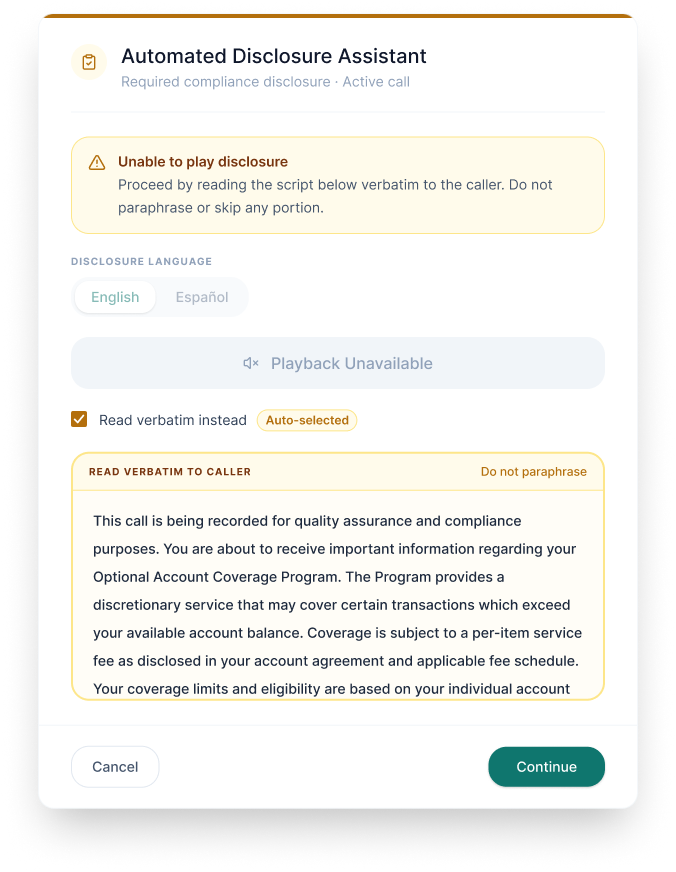
Fallback state when playback is unavailable, showing the required verbatim script

Fallback state: if playback fails, the agent is guided to read the disclosure verbatim from a clearly marked script, with no ambiguity about what to do

The automated disclosure flow is in production and has eliminated the compliance violations previously tied to manual, memory-dependent disclosure reading. By designing explicitly for the failure case, not just the happy path, the system guarantees the required disclosure language reaches the customer accurately regardless of whether audio playback succeeds.

Next Case Study

Homelab Monitoring Dashboard