Designed a net-new embedded AI panel that let call center agents ask plain-language questions and get instant, contextual answers from internal resources without leaving their workflow.
Overview
In 2024, I was part of a team that designed and shipped a net-new AI-powered support panel for call center agents at Discover Financial Services. The tool was built in direct response to agent feedback and supported by user research, agents were spending too much time during live calls searching through internal process and procedure documentation to find answers. The panel gave them a faster, more natural way to get to the right information without disrupting the conversation in front of them.
The Problem
Before this tool existed, agents relied on an internal knowledge base containing processes and procedures for handling customer scenarios. Getting to the right answer during a live call meant browsing through documentation or manually searching, a workflow that created friction at exactly the wrong moment.
The problem wasn't that the information didn't exist. It was that accessing it required agents to context-switch mid-conversation, break their focus from the customer, and navigate a search experience that wasn't built for the pace of a live call. Agents needed fast, confident answers. The existing system made that harder than it should have been.
The Goal
My Role
I was part of the core design team responsible for the panel experience, contributing to the interaction model, information architecture within a constrained panel space, and the overall UX of the AI-assisted conversation flow. I worked on how the panel would handle multiple states, how feedback would be captured, and how to design an AI experience that felt useful and trustworthy to agents who needed to move fast. User research and agent feedback were active inputs throughout the design process.
Design Approach
The panel was designed as an embedded component within the existing agent interface, accessible without navigating away from the core workflow. The decision to keep it embedded rather than a separate tool or tab was foundational; agents needed support in context, not as a destination they had to visit.
Rather than a traditional search interface, the panel was built around plain-language interaction. Agents could ask questions naturally, the same way they might ask a colleague, and receive structured, actionable answers drawn from internal process and procedure resources via an LLM.
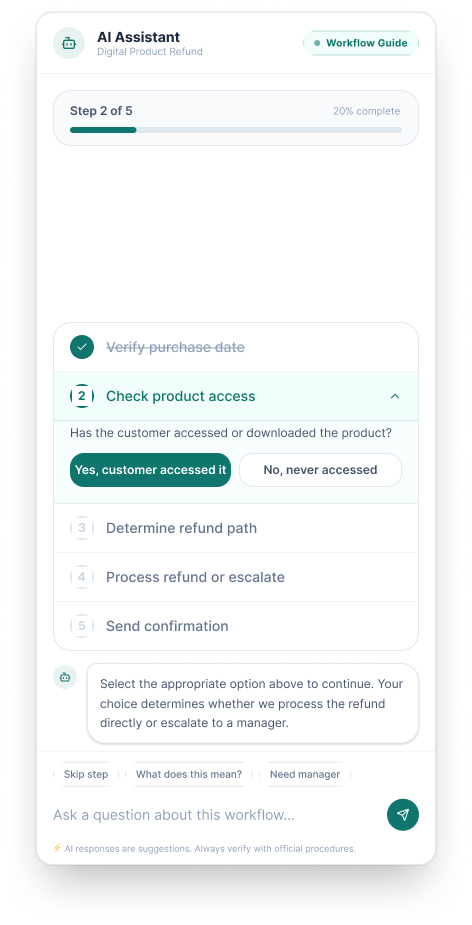
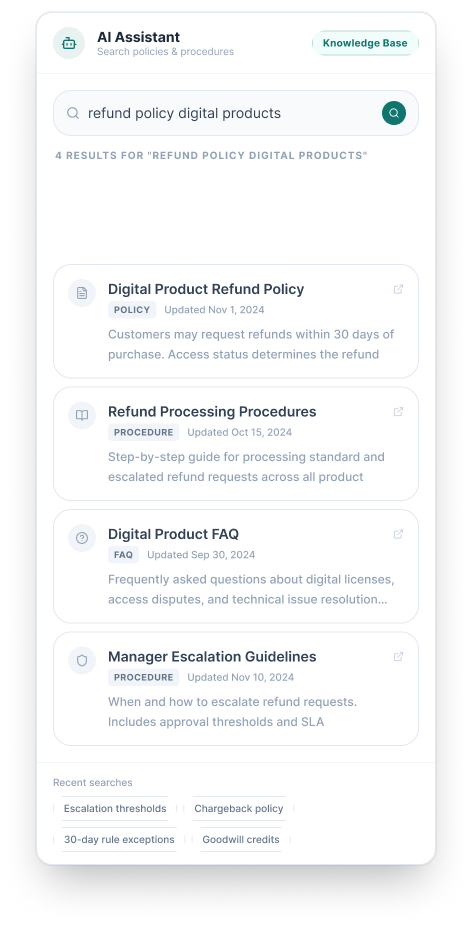
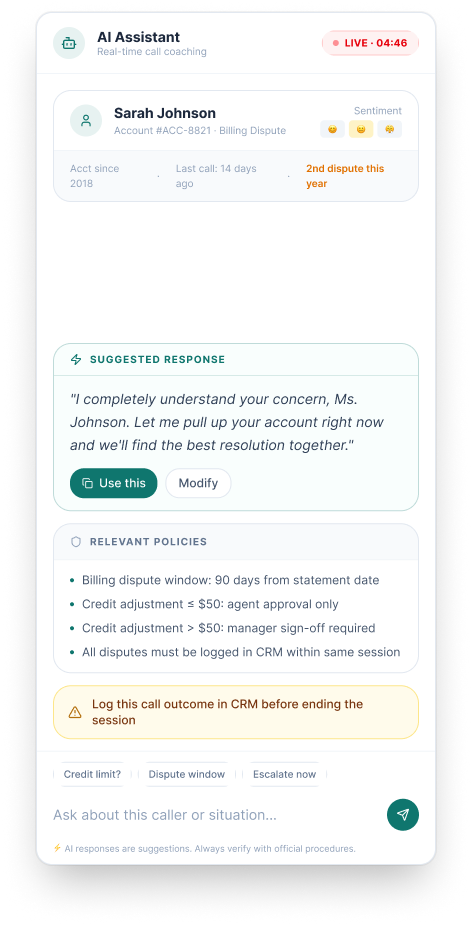
Because the panel lived in a constrained space alongside the main agent screen, the design had to be focused and lightweight. I explored multiple panel states to handle different use cases within the same component, including surfacing quick answers, providing resource links for deeper follow-up, and supporting note-taking adjacent actions.
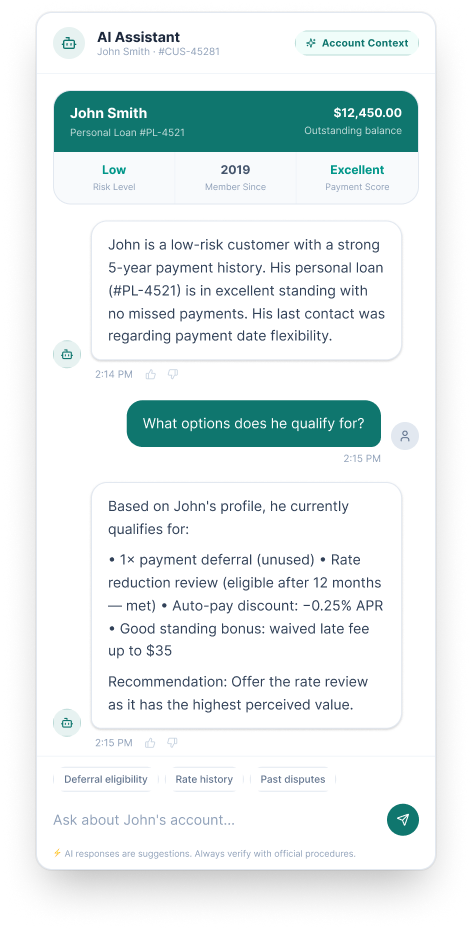
A thumbs up and thumbs down feedback mechanism was built directly into each response, giving agents a low-friction way to signal answer quality. This wasn't cosmetic; it was a deliberate design decision to create a feedback loop that could improve the tool over time.
The panel also included a persistent AI disclaimer: "AI responses are suggestions. Always verify with official procedures." This was a necessary trust and compliance consideration in a regulated financial services environment, and designing that disclaimer to be visible without being intrusive was its own small but important UX problem.
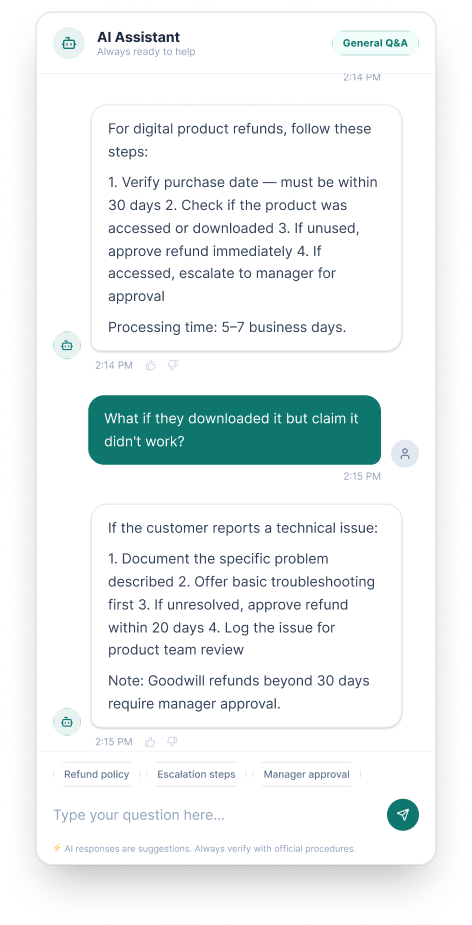
The AI Panel
The panel surfaces conversational answers from internal knowledge resources, with thumbs up and thumbs down feedback on each response and a persistent disclaimer reinforcing that AI responses should be verified against official procedures.
Representative recreation of the AI Assistant panel: plain-language interaction, thumbs up/down feedback, and persistent AI disclaimer
Outcome
V1 of the Conversational Agent Assist Panel shipped in 2024 and was used by call center agents to access internal guidance during live customer calls. Agent feedback post-launch was positive and specific enough to drive a v2 redesign, a strong signal that the tool was being actively used and that agents had meaningful opinions about how it could be improved. The v2 was in progress at the time of the Discover Financial Services and Capital One merger.